
Birds of prey on their way
This week saw the release of two birds – a buzzard and a kestrel. The buzzard came in on August 12 so was only with us for a relatively short time of 12 days.
It is a beautiful bird with a lovely white speckled front (photo by Jim Montana). It was found on the ground by a farmer and was underweight when it was brought into us.
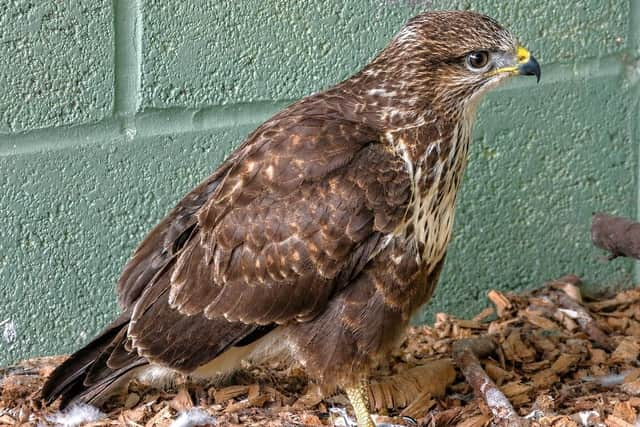

It started out in the Claw and Talon room where it could be observed more closely, then was quickly moved out to the Undercover aviary when it was clear it had no injuries and just needed feeding up and to rest.
It was fed a variety of game and recovered the weight it had lost to get ready to go.
Buzzards are the most common bird of prey in the UK and, after a low point in the mid-1990s their numbers have recovered and they are on the Birds of Conservation Concern Green List. They are easy to spot as they sit on gates and fenceposts by the roadside or can be seen soaring on the thermals high above the trees looking for prey.
The kestrel came in on July 20 after having been found in distress in Newcastle. It was with us for a couple of months. It came in with a throat infection and was underweight and hungry. It did not have any physical injuries and after being treated for the infection it was put into the JD Aviary.
It was not very scared of people, only flying away at the last minute, so thankfully it didn’t stay with us too long. It was lovely to observe, very bright and alert.
Kestrels belong to the falcon family and are in decline, their numbers dropped by 37% between 1995 and 2023, so they are on the amber list.
The release of these two birds took some of the pressure off the aviary space and meant the three owls from the Claw and Talon room could move out to bigger spaces.
This was appreciated by both the birds and the volunteers as the two young barn owls were getting to be quite aggressive and didn’t want to be handled any more. Their talons are extremely strong and sharp and can pierce through the strongest of our leather gloves.
They were also ready to stretch their wings and would spend quite a bit of energy jumping up and down on the spot with their wings out trying to get some lift. They are both now housed in the Longridge aviary.
The next of the large birds to be looking towards the door are the five tawny owls in the Long Flight. They are nearly fully grown and need to be away before the autumn weather comes in. They tend to sit on the perch by the aviary door now where they can see their surroundings, rather than in the dark back corner. They look down on us with a certain air of superiority when we go in to clean them.
There were only nine herring gulls remaining outside on Thursday and five are ready to go, providing the weather isn’t too bad for them. One of the gulls is quite a bit smaller than the others so we will probably hold a couple back so that it doesn’t have to be released on its own.