
Holy Island inspires new classical album featuring ancient Leiden Riddle
A classical album inspired by the Holy Island of Lindisfarne is set to be released this October.
Tale of the Leiden Riddle is released as a single today and will appear on a brand new album, entitled Lindisfarne: Beyond the Causeway, by composer and saxophonist Christian Forshaw, featuring renowned soprano Grace Davidson.
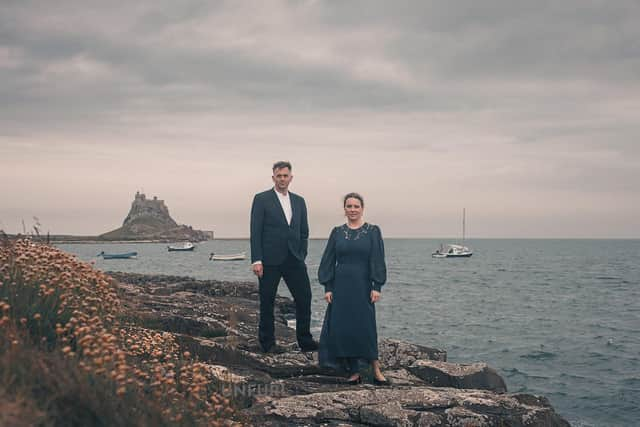

The entire album, to be released on Decca Classics on October 2, is inspired by the history of Lindisfarne off the Northumbrian coast.
The island of Lindisfarne captured the imagination of Christian Forshaw via a late-teenage obsession with a 1992 album called The Book of Kells by British folk-rock band Iona who had used an illustration from the manuscript of the Lindisfarne Gospels on their album sleeve.
Over 20 years later, Lindisfarne’s vicar emailed Christian to invite him to write and perform some music at the 2013 Holy Island Festival, during which the same Lindisfarne Gospels were going to be displayed at nearby Durham Cathedral.
Christian has performed at, and composed for, the festival on two further occasions. That music forms much of this album, which grew out of a long-standing fascination with the meeting point between landscape, spirituality and sound.
Wanting to connect with the deeper history of the region, Forshaw researched texts associated with Northumbria and discovered the ancient Leiden Riddle.
He was compelled to set this historic fragment of English poetry to music – using the unique combination of alto sax, bass clarinet, organ and voice.
“It is an otherworldly, peaceful, vulnerable and profoundly beautiful place which provides an atmosphere of pilgrimage, solitude and contemplation that feels increasingly rare in modern life,” Christian said.
At the heart of Lindisfarne: Beyond The Causeway is the voice of Grace Davidson, with whom Christian has worked for over two decades.
One of Britain's most distinctive vocal artists, Grace has appeared on projects including Hamnet, The Lord of the Rings Live, Avatar: The Way of Water and Blue Planet II.
"I wanted the music to capture what the island makes you feel," said Forshaw. "Not just the landscape itself, but the sense of peace, freedom and space to think.”