
Berwick soldier remembered as historian uncovers remarkable life before WWI
A talented artist, celebrated sportsman and veteran from Berwick is being remembered more than a century after his death.
Thomas Hope Fell is one of 473 men commemorated on a Berwick war memorial, but until now little was known about the man behind the inscription.
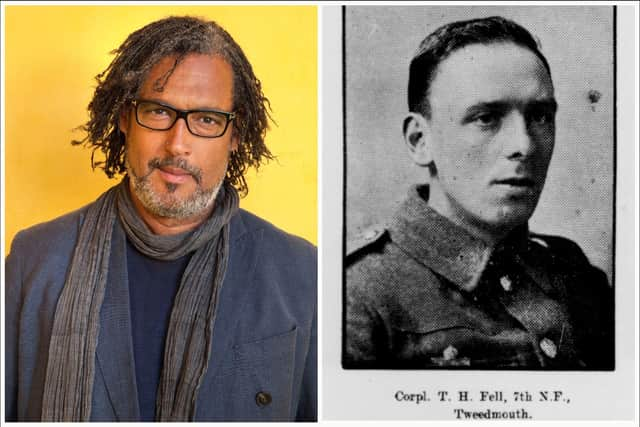

Research carried out through Findmypast's new Military Lives tool by historian David Olusoga revealed a life deeply connected to his town, where he became one of the most active young citizens before the outbreak of war.
Born in Tweedmouth around 1888, Fell grew up in a working family connected to the railway industry. As a young man he excelled both academically and artistically, earning first-class results at the Berwick School of Art.
By 1911 he was working as a colliery clerk at Scremerston. Yet it was his contribution to community life that made him particularly well known throughout Berwick.
He served as secretary of a campaign to raise £1,000 for his former school, was a prominent member of Tweedmouth Parish Church, acted as regatta secretary for Berwick Amateur Rowing Club and captained the Berwick Harriers.
When war broke out, Fell enlisted with the 1/7th Battalion, Northumberland Fusiliers. He quickly rose to the rank of corporal and was deployed to the Western Front.
However, his military service was tragically short.
On April 26, 1915, less than nine months after the First World War began, Fell was killed in action in Belgium.
A moving tribute published shortly afterwards described him as "one of the promising young men of the town" and noted that his death would leave "a gap in the ranks of the town which it will be difficult to fill."
Historian David Olusoga said: "What struck me about Thomas was not only the tragedy of his death, but the richness of the life he lived before the war.
"By uncovering stories like his, we can see these memorials not simply as monuments to conflict, but as memorials to individuals whose lives helped shape the communities we know today.
"War memorials are among the most familiar historical landmarks in Britain, but for many of us the names engraved on them have become distant and anonymous.
"Yet every inscription represents a life that extended far beyond military service and a loss that was felt by families, neighbours, workplaces, and entire communities.”