
Severe winter takes toll on Farne Islands seabirds as annual census reveals fall in puffin numbers
Puffins and several other species found on the Farne Islands have fallen in number after a difficult winter.
National trust rangers undertaking the annual census recorded a 42% drop in the number of European shags, from 96 to 56 breeding pairs.

Arctic terns fell 27%, from 519 to 377 breeding pairs, northern fulmars declined 21%, from 235 to 186 breeding pairs, and common guillemots fell 11%, from 44,059 to 39,059 individuals.
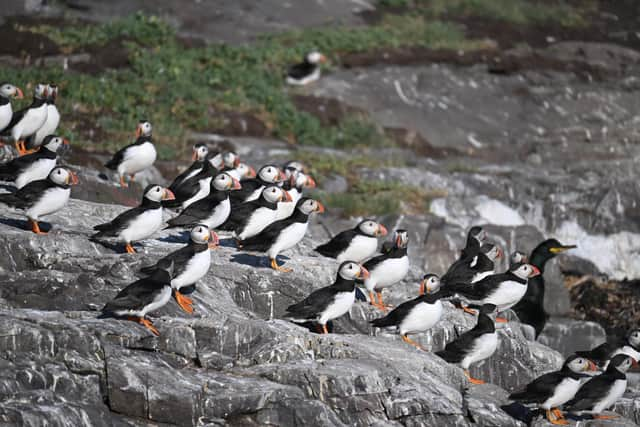
The Atlantic puffin, one of the species most affected by conditions at sea during the winter months, saw breeding pairs fall by 12%, from 38,559 to 33,939.
Longer-term monitoring also points to a downward trend, with the population declining by 22.8% since 2018 despite some year-to-year fluctuations. Similar declines have also been recorded at neighbouring puffin colonies.
Sophia Jackson-Chaytor, senior ranger for the National Trust on the Farne Islands said: “Puffins and shags are both particularly vulnerable to severe winter weather.
"When severe storms come one after another there can be very little respite. The number of birds returning to the Farnes each spring reveals much more about their lives than what has happened here on the islands. We're also seeing the consequences of conditions they've encountered at sea throughout the winter."
However, there were encouraging signs once the birds returned to breed with a rise in the average number of chicks successfully fledged per occupied burrow.
Rangers are investigating the impact of grey seals on puffin nesting areas, including research comparing soil density in areas heavily used by seals with those occupied by puffins.
On parts of Inner Farne, patrols, scarecrows, and sound-based deterrents are used to discourage seals from moving across sensitive breeding areas and disturbing or compacting burrows.
Sophia added: "Puffins spend most of their lives out at sea, so when they return to the Farnes to breed, we want to do everything we can to give them the best possible chance.
“Interestingly, while puffin numbers declined across the Farnes overall this year, Inner Farne bucked the trend, increasing slightly from around 20,000 to 20,323 breeding pairs. We're looking closely at why puffins appear to be doing better there, including differences in their nesting habitat.
“If we can understand what is making some areas more resilient for puffins, we can use that knowledge to help protect and manage their breeding habitat across the islands in future.”
Avian influenza took a heavy toll on colonies in 2022 and 2023, while changes in the availability and distribution of key food sources such as sandeels can affect birds' ability to breed successfully.
However, there were some species that had a more positive year. Black-headed gull numbers increased by 55%, from 128 to 198 pairs.
Razorbill numbers increased by 17%, from 408 to 478 pairs. Rangers also recorded four gadwall nests following the species' first-ever breeding record on the Farne Islands in 2024.
Professor Chris Redfern of Newcastle University, who reviews and validates the seabird data said: “These are challenging times for the Farnes' breeding seabirds.
"Many of the pressures affecting seabirds originate far beyond the Farnes themselves. Human activity influences the marine environment at global, national and local scales, and human-driven changes to that environment, combined with disease and extreme weather, are likely contributing to declines in some breeding species.”