
Exact time to be in position to see solar eclipse in Northumberland
A partial solar eclipse should be visible in Northumberland on Wednesday, August 12.
The weather forecast is set fair for the crucial two hour period when it takes place.
A solar eclipse occurs when the moon passes directly between the Earth and the sun, resulting in the moon casting a shadow on the Earth.
Around 90% of the sun will be covered by the moon in our region – the most coverage in the UK since 1999.

After 6pm (timings vary slightly for different parts of the UK), ‘first contact’ - when the moon first covers part of the sun - will occur. The moon will then move slowly in front of the sun.
At the eclipse’s maximum, enough of the sun will be covered to make a noticeable difference in the temperature and light levels.
However, unlike with a total eclipse, the sky will not become dark. It will feel more like a cloudy day or close to dusk or dawn.
After the maximum, the moon will begin to move off the sun’s disk until the eclipse ends at 8pm or after.
It will be best viewed from locations across Northumberland with a clear view to the west.
Elevated locations such as Bamburgh Castle, which is opening its gates late for the event, provide the perfect viewing spot.
The next total solar eclipse visible from the UK will not be until 2090, with the only eclipse that’ll come close to total for the British Isles beforehand being September 2081 - when up to 99% of the sun will be obscured by the moon.
Why it’s important to watch a solar eclipse safely
The Sun appears dimmer than usual during an eclipse. The reduced brightness of the Sun can override the body's natural reflex to look away - allowing intense sunlight to reach and damage the retina. The damage happens without causing pain so you may not realise it’s occurring until it’s too late.
Why sunglasses are not adequate protection for watching a solar eclipse
Ordinary sunglasses - no matter how dark - don’t provide adequate protection for watching a solar eclipse. Sunglasses reduce glare, making it feel more comfortable to look at the Sun for longer, while still allowing harmful solar radiation to reach the retina. Never use regular sunglasses to look at the Sun during an eclipse.
How to watch a solar eclipse safely
There are two safe ways to watch a solar eclipse - specialist eclipse viewers or indirect viewing methods.
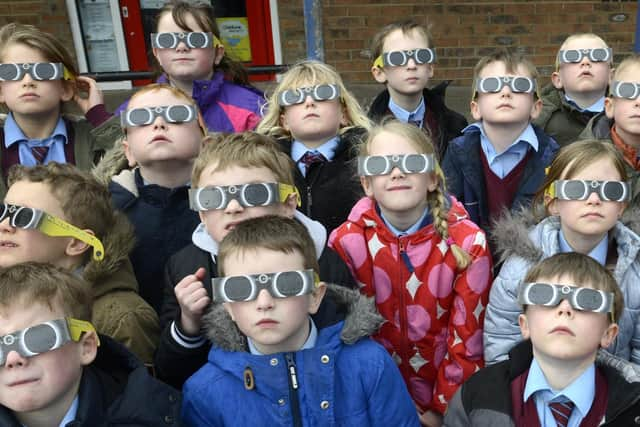
If using eclipse glasses or handheld solar viewers, make sure they are genuine with specially designed filters that meet the international safety standard ISO 12312-2:2015(E). Don’t use the product if you’re unsure it’s certified or if the lenses are scratched, torn or damaged.
You can watch the eclipse indirectly by using a pinhole viewer (which you can make at home), viewing the Sun's image projected through a colander or the gaps between tree leaves or projecting the Sun's image onto a sheet of paper using a simple pinhole projector.