
Autumn heralds nature’s fireworks display
Autumn may well be a period of winding down in the garden for some, but it still has plenty of surprises in store.
Over the past fortnight we’ve visited a few ‘open to the public’ sites locally and revelled in the emergence of plants on our own plot.
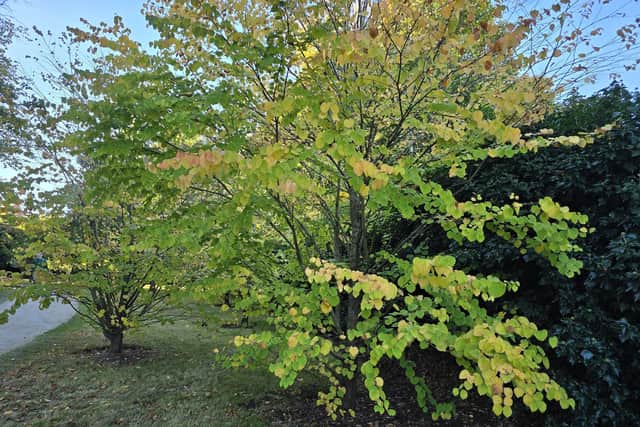

Most obvious highlight is the eye-catching colour change in the leaves of deciduous trees and shrubs, a natural annual phenomenon that coincides with the seasonal fall in temperature and reduced daylight.
The process involves the breaking down of green chlorophyl, key to food making, and its transfer from leaf to parent plant. This reveals other colourful chemicals (carotenoids), that were previously masked but now provide the spectacle. These are; beta-carotene (orange), xanthophyll (yellow) and anthocyanins (red).
Once chlorophyll reabsorption is completed the leaf becomes detached and confined to the composting facility, and the tree or shrub enters dormancy.
I see this colour change as nature’s fireworks display but of course it lasts much longer. How long depends upon the weather. To keep the current show on the road we need a series of warm days followed by cooler nights and no strong winds!
Make use of this current spectacle if you are able by visiting the countryside or gardens open to the public. Looking beyond that experience you may well decide, with nature’s planting time approaching, there’s room for such a plant in your garden.
Unfortunately, three personal favourite autumn leaf colour trees, Gleditsia triacanthus ‘Sunburst’, (honey locust), Cercidiphyllum japonicum, and Metasequoia glyptostroboides, (dawn redwood) would grow far too tall for this garden. However, there are lots of medium-sized shrubs suitable for smaller plots or container cultivation.
The leaves of Viburnum ‘Dawn’ are beginning to turn a reddish brown, and pink-scented flower clusters that will decorate the bare stems all winter long, are just opening. In springtime, two yellow-flowering forsythias are star attraction and they save their last act, a colourful leaves encore, until now.
Fothergilla major has long been a favourite, thanks to the outstanding leaf colour change. White flowers appear on the bare stems in spring. Their small, bottle brush form is a novelty rather than outstanding, but when autumn arrives wow! Red and yellow leaves that closely resemble those of a family group member Hamamelis mollis (witch hazel).