
'Smiling' fossil discovery on Holy Island sparks worldwide attention
A ‘smiling’ fossil has gone viral after being discovered by a tourist on Holy Island.
Christine Clark visits Northumberland every year on holiday with her husband. The pair often visit Holy Island where they have a friendly competition of who can find the most St Cuthbert’s Beads.
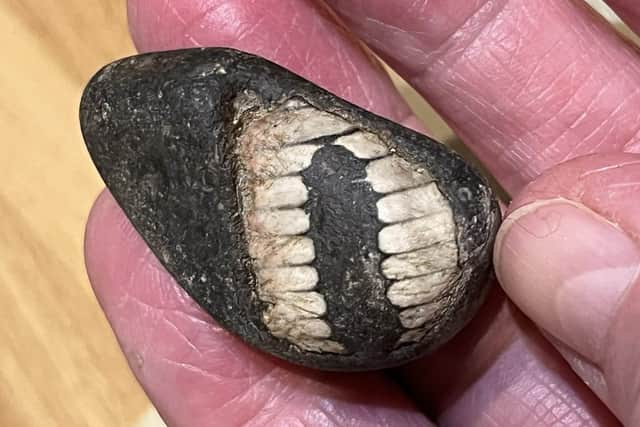

However, on a Boxing Day walk, Christine found more than she bargained for when she came across an extremely unique-looking fossil.
“I saw something that looked like teeth,” she explained. “I went down to pick it up and realised it was a fossil.
"When I caught up with my husband, I showed him it and we just burst out laughing, he thought it looked like an alien.”
After posting a photo of the fossil on a Facebook page, thousands of comments flooded in suggesting that the fossil was in fact a marine animal.
It has now been confirmed by the British Geological Survey to be a large part of a crinoid – an ancient marine animal with a history spanning more than 500 million years.
The individual discs that make up the stem of a crinoid are the St Cuthbert's beads that Christine originally went out looking for.
“I never would have thought that it was an animal, but I am now more interested in fossils than I was before,” Christine added.
"A lot of my friends have now been sending me photos of fossils asking what they are like I am a famous fossil hunter!”
Christine’s son-in-law got in touch with the BBC who decided to shoot a short film on Holy Island, which has now been followed by multiple radio interviews and news stories across the world.
“The story has gone all over the world now, it’s everywhere. Radio Lincolnshire contacted me the day it went out and said, ‘Do you realise your item is the most read item in Britain today?’”
"I just want it to bring happiness to people and a bit of fun, lighthearted news,” Christine added.