
Rothbury golf course taking inspiration from Augusta as it boosts its biodiversity
Michael Axtell is the captain at Rothbury Golf Club. He began playing golf in his thirties, and when he moved to the North East he tried several different clubs until he found his place at Rothbury.
"It was just so friendly and welcoming, with fantastic views,” he says. “I felt at home straight away.”
Michael had always been impressed with Augusta, where the US Masters is played.
"It is the beauty of the course,” he explained. “It is as famous for its beautiful azaleas as it is for the fabulous course.”

More than 30 varieties of this plant grow all around the course. The 13th hole (named Azalea) contains more than a thousand of these pretty shrubs.
The directors of Rothbury Golf Club soon realised that their new captain, and board member, was a person who liked a challenge and enjoyed thinking of novel solutions to difficult questions.
The question he is faced with is,’ how to raise more revenue, and increase footfall’?
For Michael, the answer lies in making the club a real centre of the Rothbury and Coquetdale community for golf, and for many different activities.
To this end he has already organised many leisure pursuits, from learning to draw, to Pilates.
Michael explains: “The club house is probably the largest community facility, with a serviced bar, in the Rothbury area, and we are keen for people to make use of it.”
However, it wasn’t just about getting more people in through the door for activities.
Michael kept thinking back to the iconic azaleas of Augusta. And from these thoughts he began to draw up a plan.
It would be brilliant if Rothbury Golf Course had its own iconic flower – planted in many places, a joy to see, and to be visible at different places, throughout the course.
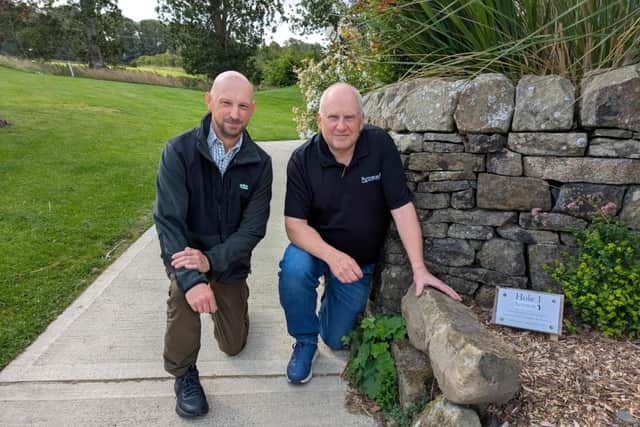
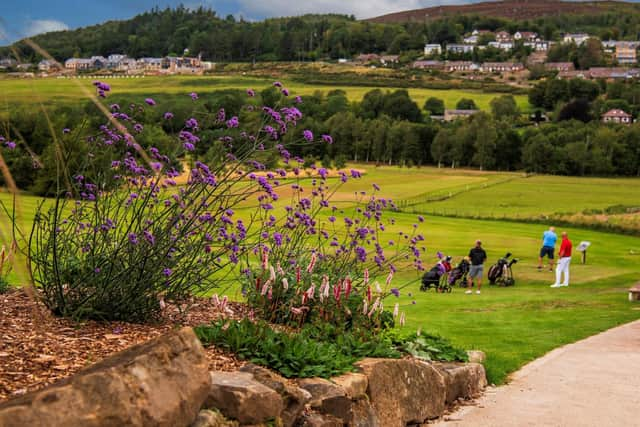
As a start, he decided to make the first hole a much more attractive and biodiverse area than it was. A lovely stone wall made a space that could become pollinator friendly and look lovely.
Michael decided to get in touch with Ed Bishop from Stanton Hall Gardens and Nursery, Morpeth.
The nursery grows a great many annuals from seeds, and perennials from propagation of the plants in the gardens. They also have a fine selection of herbs, shrubs and trees.
Michael had no doubt that Stanton staff had the experience and expertise for what he wanted, and he explained to Ed what he was thinking about for the golf course.
Ed advised getting native plants, not too appetising to the many deer and rabbits who enjoy coming onto the course. Plants that look lovely, but are also pollinator friendly, were what Ed suggested.
Michael agreed, and so between them they planted up the first hole. Already a host of insects are enjoying exploring them.
The next stage of the planting will take place in spring. Ed and Michael will begin work on the rockery at the entrance to the club, tidying it up and planting appropriate vegetation.
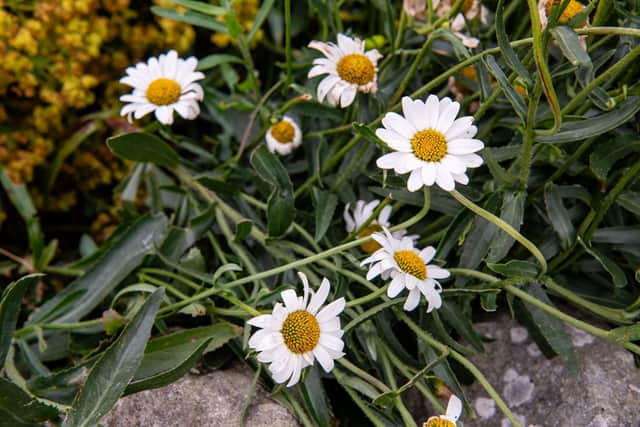
Thinking about which would be the iconic Rothbury Golf Course flower, they decided on the ox-eye daisy.
You may know this pretty plant as a marguerite, or dog daisy, or, perhaps, moon daisy – named because of the way the flowers appear to glow in the evening light under a full moon. Ox-eye daisies are very important for various pollinating insects, including butterflies. Birds and small mammals eat the seeds, so it is an excellent plant to choose, in terms of both beauty and for the ecosystem.
There are plenty of them already growing in places, but the idea is to plant more, and for them to form an iconic daisy chain which will echo throughout the course.
Even more exciting are the longer-term plans, which they are busy devising.
Looking around the beautiful 18-hole course, golfers can enjoy seeing the hedging and the many trees. But there are also areas that could potentially be used for, perhaps, wild meadows, and wetlands.
One of the groups within Rothbury Climate and Nature is called ROWANS, which stands for Recovering Our Wild And Natural Spaces. People with expertise in this group will be talking with Michael about what could be possible. They may well offer their help with practical tasks also.
The future of the club looks very bright. Not only the club as a venue for community events, but the course itself as an area which will include many different habitats for a range of insects, invertebrates, birds, and mammals.