
Northumberland reaction to Government plans to ban trail hunting
Pro and anti trail hunting groups have reacted to an announcement that it is set to be banned.
As part of its new animal welfare strategy, the Government says that it plans to “put an end to trail hunting and will consult in early 2026 on how to deliver a ban on trail hunting” in England and Wales.
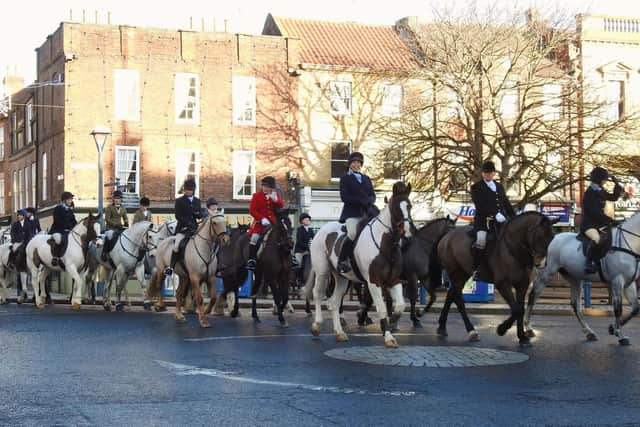

The practice sees an animal-based scent trail laid for dogs to follow rather than a real animal, while a group of hunters follows the pack on horseback. It has remained legal since the 2004 hunting ban came into force, because it does not explicitly involve the killing of animals.
Hunting groups and countryside organisations have said that as well as taking away something that brings communities together, it would also harm rural economies across England and Wales.
A spokesperson for the Morpeth West Percy Hunt said: “Trail hunting is not a marginal pastime – it underpins a rural economy worth more than £100million a year.
“That economic activity is felt in places like Morpeth and across Northumberland: farriers, vets, feed suppliers, fencing contractors, mechanics, grooms, local pubs, village shops and countless small family businesses rely on the activity remaining lawful and well-regulated.
“For many communities here, the hunt is not simply a fixture on the calendar but part of the social fabric. Meets bring people together who may otherwise be isolated, support local services that struggle to survive and help keep money circulating in small market towns and villages. That is why so many farmers, landowners and rural workers are deeply concerned.
“A ban would remove the economic base that sustains hundreds of hounds and horses, damage jobs, and weaken already-fragile rural communities.
“At a time when public services are stretched and rural areas often feel overlooked, it is hard to see why this is being treated as a political priority.”
Robert McCarthy, Huntsman with the Percy Hunt, said: "Trail hunting is really popular in this area. It’s not just the riders themselves there are many more people who follow the hounds on foot – it’s all part of the day. There are a lot of misconceptions about trail hunting, but we do everything within the law."
Olly Hughes, managing director of the British Hound Sports Association, commented: “Trail hunting has no impact on wildlife. The hounds follow a scent trail, demonstrating their skill, while providing an exhilarating challenge for the riders. The Hunts are also at the heart of social life in many areas, bringing people together who might otherwise be more isolated.
“Since the Hunting Act became law, there have been an estimated 280,000 days of trail hunting, with fewer than 50 convictions of BHSA-accredited Hunts – equivalent to just 0.02%.
“Banning trail hunting would be a severe blow to many rural communities and damage the economy, also bringing to an end traditions that have endured for hundreds of years.”
Northumberland Hunt Watch supports the proposed ban.
Member Lynne Graham said: “Trail hunting is a fig leaf for foxhunting, a practice that both the public and Parliament rejected as outdated and cruel over 20 years ago, and which enables cruelty to continue under the guise of compliance.
“Banning trail hunting will reflect contemporary attitudes toward respect for animals. A ban would align the law with public expectations and restore confidence that animal protection legislation is meaningful and not easily abused.
“If this were truly about riding, tradition, social activity, or jobs, hunts could convert to clean boot hunting, which preserves these elements while providing a lawful and humane alternative, by following the scent of a human runner.”
The RSPCA has said the UK government’s new animal welfare strategy is an ‘important first step’ to improving millions of animals’ lives.
The strategy includes measures to tackle cruel practices such as: cages for laying hens, pig farrowing crates, and CO2 pig stunning; snares and trail hunting; the extreme breeding of dogs and the promotion of slower growing meat chickens.
RSPCA Head of Public Affairs David Bowles said: “We need a robust Animal Welfare strategy, because the way we breed animals, rear them for food, sell them for profit, use them for sport or encroach on their habitat can have unintended consequences for their welfare.”