
Northumberland Fusiliers' sacrifice remembered on 110th anniversary of Battle of the Somme
Tributes have been paid to Northumbrian soldiers who died on the first day of one of the bloodiest and most notorious battles of World War One.
July 1 marked the 110th anniversary of the Battle of the Somme.
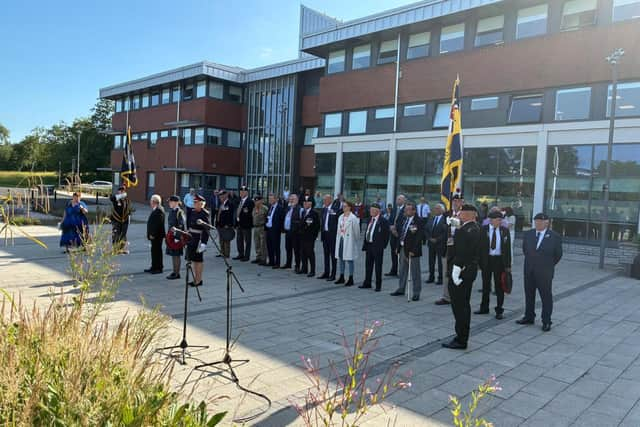

A special service was held at Northumberland County Hall to mark the occasion, with a focus on the county’s local regiment.
The Northumberland Fusiliers suffered the highest number of casualties of any regiment on the opening day – which has gone down as the single bloodiest day in the history of the British Army.
There were more than 57,000 British casualties on the first day of the battle, and of those, 19,240 men were killed in action or died of their wounds. Current veterans attended the service of remembrance at the council’s headquarters in Morpeth alongside local dignitaries and officials.
The council’s civic head Coun John Beynon said: “A generation of young men stepped out of the trenches. Many of our ancestors fought in the war and many sacrificed their lives.”
Council leader Glen Sanderson, who has visited the battlefield in the past, added: “It is incredible to go and consider what actually happened there 110 years ago.
“The Northumberland Fusiliers, for it is they that we particularly remember at the county council, were thinking about their homes in Northumberland – in Wooler, Cornhill, Morpeth, Alnwick and Berwick, and thinking about their family and friends.
“Then they went over the top. They were told to march towards the Germany Lines and were to told to carry on whatever happened. As we know, the bombardment that was to have destroyed the trenches, the machine guns and the barbed wire had failed.
“These men walked to their death. Because of that link with the Northumberland Fusiliers, we see today that it is just as important and just as relevant as it was then to remember those Northumbrians, like us, who came from different backgrounds, who did their duty and died or were seriously injured to make their mark, do their bit and play their part in standing for democracy and freedom.”
Chester Potts served with the Royal Regiment of Fusiliers, the successor unit to the Northumberland Fusiliers. He gave a visceral account of the conditions faced by soldiers at the time, describing it as the “biggest disaster in the history of the British Army”.
He continued: “The casualty rate was horrendous. Men were forced to march a mile in open ground, wave after wave was cut down.
“150,000 men died. There were 400,000 casualties for the gain of just seven miles. In the German Spring Offensive in 1918, most of that land was lost.
“72,000 men still lie out there. When you walk out there, you walk on their bodies.
“They left us a legacy of democracy and freedom. They should never be forgotten.”
As well as the service, the council is working with Northumberland Archives to highlight some of the personal stories and sacrifices from the Battle of the Somme. A new display will run in County Hall, a special website is being created, and there are plans for a touring library exhibition over the coming months.