
Conservationist rediscovers rare moth colony after more than 70 years at site in Northumberland
A conservationist who has spent many years searching for a second colony of one of England’s rarest moths has said achieving his goal in Northumberland “was one of the highlights of my career”.
Dr Dave Wainwright of Butterfly Conservation also said that he felt an “overwhelming feeling of relief” after discovering the hidden population of Dark Bordered Beauty at the National Trust’s Wallington estate.
The custard-and-chocolate-coloured moth was found at the site previously, but had not been seen there since 1952.
For decades, the only site where it was found in England was Strensall Common in Yorkshire. However, the population there has been rapidly declining, partly due to climate change, and wildfire has ravaged part of the site.
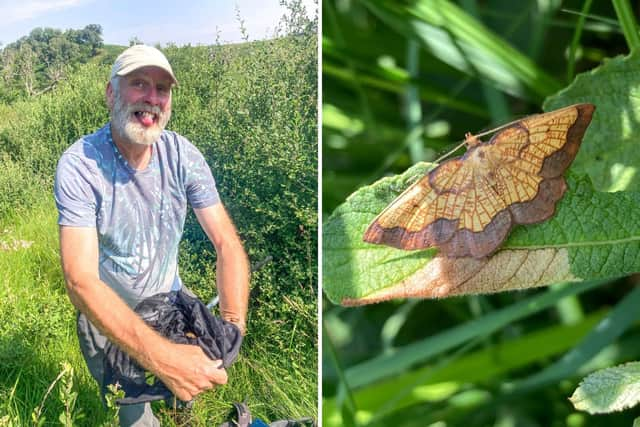

But now England has a second population of Dark Bordered Beauty, providing a new hope for the future of this fragile species.
Dr Wainwright, who is head of conservation in England at Butterfly Conservation, said: “I was hopeful – I’m always hopeful – but I definitely didn’t expect it because I’ve been to so many sites to look for this species over the years, so my heart and my head were in two different places.
“We rocked up on site and within a few a minutes we found one. It was one of the highlights of my career.
“Overwhelmingly, it was just a feeling of relief that we weren’t just fighting the fight at one site anymore.”
The Dark Bordered Beauty is a day-flying moth which has lemon yellow wings with a deep chestnut border.
For several years, the National Trust has been working with the tenant farmer who manages the site, Fiona Goodfellow, to improve this precious habitat through nature-friendly farming. This approach has allowed the moth’s food plants to thrive.
Last year, Butterfly Conservation received £300,000 from Elgol Fund for Nature for a new project and as part of this, Dr Wainwright arranged to visit Wallington recently with project officer Charlotte Rankin and National Trust rangers.
He added: “It only took 10 minutes to find the first one, then we all started picking them up quite regularly.
“This opens up a new front in our knowledge of the species in England. We have very fixed ideas of what good habitat looks like based on Strensall, but actually the habitat at this new site is different.”