
Reward for efforts as barn owl released by Berwick Swan and Wildlife Trust
The barn owl that we have been writing about over the last couple of months was released this week which is great news.
A number of barn owls are brought into the Rollo Centre each year, generally after being hit by vehicles and many don’t survive, but over the last few years an average of two per year have been ringed and released.
I have been reading a beautifully illustrated book called
“The Owl: A Biography” by the naturalist Stephen Moss and it has some fascinating information about the life of barn owls that I’d like to share.

The barn owl has been around in the UK for about 5,500 years but has been uncovered in historical remains over 10,000 years ago in the Middle East. They are found widely across the world reaching Australia, the Falklands and even Hawaii.
In the 1940s, barn owls began to turn up in New Zealand, assumed to have hitched rides on boats but in the early 1980s, they were discovered inside the wheel housing of a Boeing 747 at Auckland International Airport and must have hitched a ride from Australia given the insects that were in their stomachs.
Barn owls have been called ghost owls, due to their colouring, and also screech owls, due to their call which can sound like a kind of scary spectre. They are a different colour and pattern to other owls, very pale and plain, with a lovely heart shaped disk that frames the face. They have large, rounded wings and the dense soft feathers mean they are virtually silent in flight.
The male is white underneath and surprisingly they have been found to hunt more successfully when there is a full moon, it has been measured that voles freeze when they see them for a measured five seconds longer when the bird is very white underneath!
Although they mostly hunt either at dawn or dusk, or during the night itself, they also regularly do so by day. Usually following a period of rain when flying has been impossible.
Their soft feathers quickly become waterlogged if they fly in the rain. They have been known to get into trouble falling into sources of drinking water, perhaps seeing their reflection and leaning too far forward.
Barn owls generally nest in barns where there is a good supply of mice, but they are also regularly found breeding in the towers of castles and churches. Some pairs roost together throughout the autumn and winter, calling to each other and sometimes preening each other.
They are faithful to one another and to their nesting site; they and their descendants may use the same nest for at least twenty or thirty years. Typically, they lay between four and six eggs in mid-April, the female incubates them, and the male brings the food. They fledge between seven and a half and nine weeks later. The number of chicks that reach the fledging stage depends on the supply of voles and other food in that particular year and in leaner years the parents will favour the stronger two chicks.
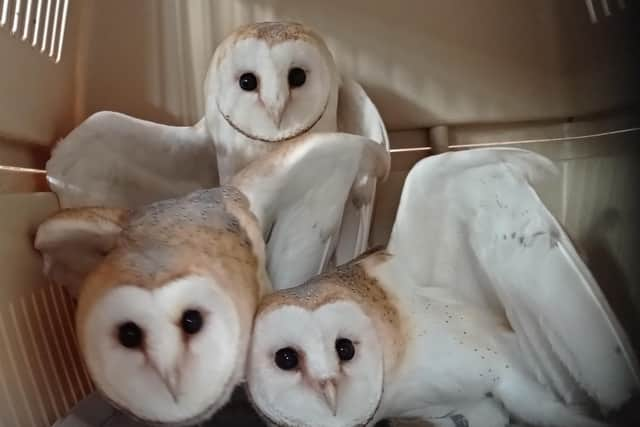
In 2022, three youngsters were brought into the Rollo Centre that were stranded when the tree they were nesting in was cut down. All three were hand reared and released although one of the three was always a bit weaker and did come back for a second visit to feed it up.
Like all birds, these lovely owls are threatened by loss of habitat and changes in farming methods and it is rewarding that we are able to help even a few of them.
Gill Powell