
Sycamore Gap Tree's true age: Study by Historic England reveals how old the iconic tree was when felled
New research published by Historic England has confirmed a minimum age of the iconic Sycamore Gap tree.
Evidence suggests that the Northumberland tree was at least 100 to 120 years old when it was illegally felled and probably appeared in the landscape in the late 19th century or earlier.
The dendrochronological (tree-ring counting) investigation by Historic England’s national Investigative Science team was carried out in September 2023.
The investigation is the first research into the age of the Sycamore Gap tree to have scientifically analysed a sample of the tree itself.
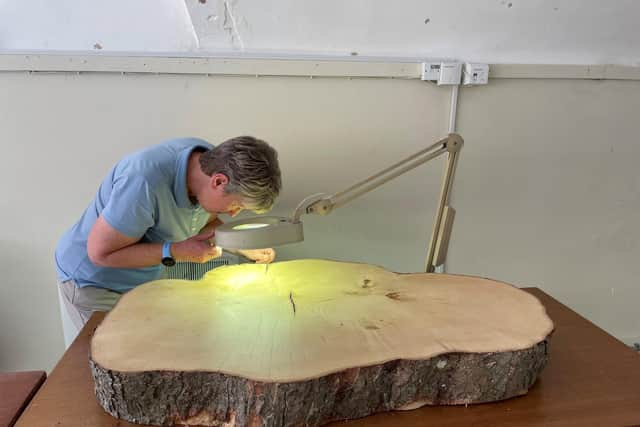

By counting the sequence of tree-rings taken from a cross-section of the felled part of the tree, researchers were able to arrive at an estimated count of 100-120 growth rings for the two main stems – with each ring indicating one year of growth.
Zoë Hazell, senior palaeoecologist in Historic England’s Investigative Science team, said: “It has been a privilege working with colleagues on such an iconic tree and being able to contribute to our knowledge and understanding of its history in the landscape.
“Retaining the slice in HE’s National Wood Collection will ensure that it is kept safe for the nation.”
This research only provides an initial estimate of the tree’s age by counting its rings at the point where the sample was taken.

Historic England is currently exploring a range of other potential research techniques that could provide a more accurate tree-ring count, including using advanced imaging techniques in conjunction with the University of Exeter’s Digital Humanities lab.
Cathy Tyers, dendrochronologist in Historic England’s Investigative Science team, added: “The research provided some challenges, such as the ring boundaries of sycamores being less obviously defined than some other tree species.
“I hope that this research adds further to its fascinating story and contributes to its remarkable legacy.”
As well as establishing a minimum age for the tree, some high magnification images were taken to highlight the tree’s characteristics at a microscopic level.
The slice of the tree used for the scientific analysis has been stored securely at Fort Cumberland. It is expected to be added to the Historic England National Wood Collection and made available for potential future research.