
Puffin count underway as National Trust marks centenary year of caring for the Farne Islands
The annual puffin count on the Farne Islands is underway in what is also the National Trust’s 100th year of caring for the archipelago off the Northumberland coast.
This year’s count, alongside recording other seabird numbers, is vitally important given the islands’ three seasons of closure between 2020 and 2024 firstly due to Covid-19, followed immediately by bird flu.
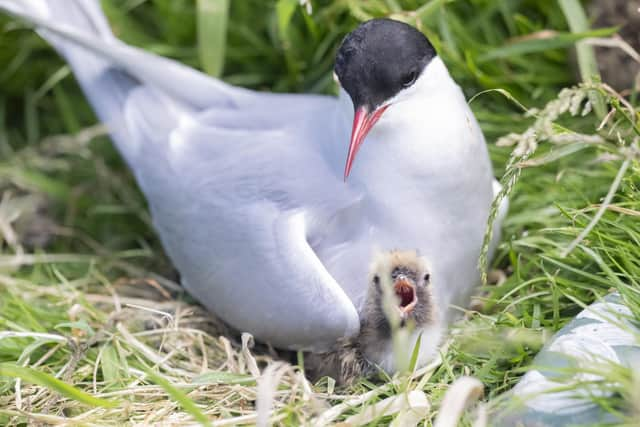
Seabirds that make the annual migration to breed include cliff-nesting birds such as razorbills, guillemots and kittiwakes, ground nesting birds such as terns (Arctic, Common and Roseate) as well as the endangered puffins who build burrows underground to lay their eggs and once hatched, to raise their ‘pufflings’.
Sophia Jackson, area ranger on the Farne Islands for the National Trust revealed: “The earliest official scientific records for seabirds date from 1913.


“Reports for the majority of returning bird species started in the 1920s thanks to the ‘watchers’ stationed on the islands over the summer period, and in 1939 puffins were particularly noted as increasing.
“It appears that the increases in bird species aligns with the islands gaining increased environmental protections, firstly through designation as a Site of Special Scientific Interest (SSSI) in 1951 and as a Special Protected Area (SPA) in 1985.
“Significant milestones include numbers of breeding birds reaching 100,000 for the first time in 1987, with 200,000 individual seabirds returning recorded in 2005.
“Looking back on the records for the different populations it is very clear how important regular monitoring of the different seabird populations has been – despite different methodologies - for informing our conservation work on the islands, but also for keeping track of the impacts of climate change through warming seas and more frequent storms.
Sophia continues: “We submit our data to the British Trust for Ornithology (BTO) and the Seabird Monitoring Programme (SMP) so our data can be used by researchers and for other studies.
“Other sites submit their data into these sources, to give a complete picture of what is happening to the various populations.
“Last year’s counts were particularly important as we had been unable to conduct full counts on the islands since 2019. It was a huge relief to discover that the puffin population was ‘stable’ with 50,000 pairs recorded, but other species were less fortunate with big losses for terns and shags mainly due to bird flu and winter storms.
“Both species have struggled in the last decade due to the weather and declines in fish stocks. Ultimately, they both need time to recover. We can help by keeping their nesting habitats as safe as possible for them to return to in the light of climate change and the increase of extreme weather events.”
To help monitor the puffins and to gain further insights into these ‘clowns of the sea’, the team is introducing a new way to track the birds using coloured rings – the second such project in England.
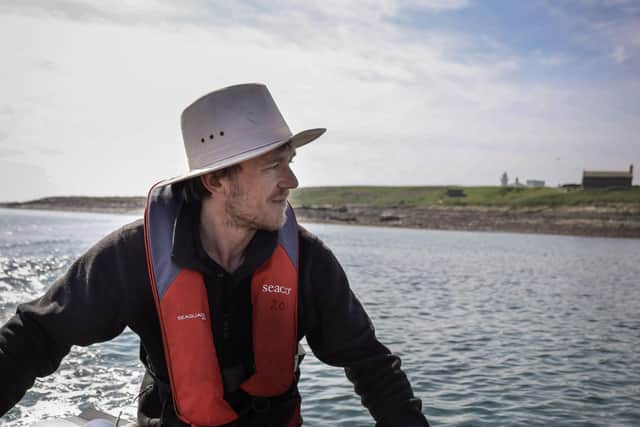
Tom Hendry, who has been part of the ranger team since 2016, explains. “Despite puffins spending much of their time ‘rafting’ out at sea, ringing them will help us to understand more about the individuals as we’ll be able to follow them over several years, as well as how long they live and how far they travel to other colonies
“Over the next few weeks, we’ll aim to ring 50 adult birds as part of our census and productivity monitoring.
“Reported sightings of these blue colour rings by other rangers from other organisations and the public, will indicate that these adults breed on the Farnes, and are vital for this project.”
Other techniques used over the years to better understand the various species have been through ringing and also geolocation tags which were put on some Arctic terns in 2015 and retrieved in 2016.
Sophia commented: “In using tracking technology we were able to discover for the first time just how far the Arctic terns travel during their annual migration with distances of up to 70,800 miles recorded – or to put this into context, close to three times around the globe each year which means they witness two summers! When you think about what that means over the lifetime of one of these tiny seabirds, it is nothing short of incredible.”
The team on the Farnes have been supported in recent years by researchers at Newcastle University to aid more understanding of the different populations.
Keeping accurate records of the birds over the years has been vital. Dr Anne Wilson has been the Trust’s Volunteer Archivist for the Farnes since 2005. She first became interested in the islands in 1986 and created the database of bird records that is still used to this day.
She says: “It’s hard to know what the famous bird colonies will be like in 50 or 100 years. Because of rising sea levels and warming seas, we could be seeing an entirely different position on the Farne Islands. When the seas warm, the fish and plankton the birds depend on will migrate further north – and won’t be in sync with the birds’ breeding seasons.
“But, hopefully, after these first 100 years, we can build on what’s been achieved.”
To help mark the 100th anniversary the conservation charity wants to ensure more people than ever before can experience the seabird breeding season with two live web-cams; one trained onto the puffin burrows and the second on the cliff nesting birds at www.nationaltrust.org.uk/farne-islands-webcam
Sophia comments: “We hope by seeing the birds, people will be inspired to visit in person one day, but also to realise just how special these wild isles are, and how we must do all we can to ensure these islands and bird species have a long and healthy future ahead.”