
Blyth beach pollution investigation suggests creosote contamination
Preliminary investigations into pollution at Blyth beach suggest creosote contamination.
A ‘strong-smelling substance’ forming a sheen in water and on the sand was first reported on August 11.
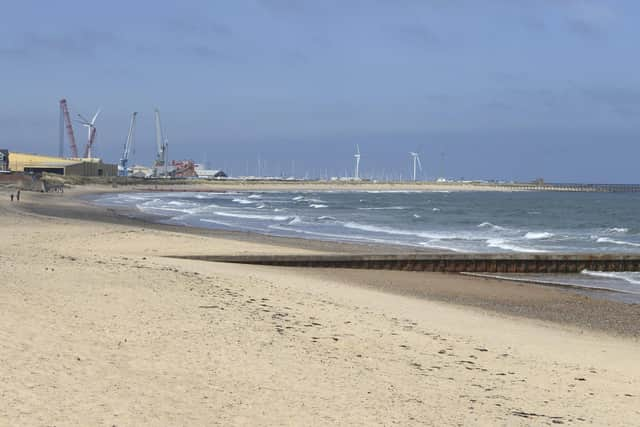

A new statement issued on behalf of the Environment Agency, Northumberland County Council and the Port of Blyth explains that there have been investigations into historic industrial land use in the area to help identify the potential source of the pollution.
The statement adds: “Preliminary analysis of samples taken by the Environment Agency suggest creosote contamination within the affected area and, as a precaution, restrictions are currently in place on both the land access and bathing in the affected area (north of the Dave Stephens Centre).
“There is also a temporary restriction at the Hole in the Wall entrance to the beach to ensure the safety of visitors and the public while further analysis is ongoing. Initial water samples indicate that the bathing water site south of the Dave Stephens Centre remains unaffected.
“We appreciate the impact these restrictions have on residents, visitors and local businesses and we will provide further updates as more information becomes available.
“Members of the public are asked to follow all the signage and advice that is in place.”
The contamination is largely contained within the sand and any pollution that does reach the bathing water is expected to be heavily diluted by the sea.
Northumberland County Council has posted the following Q&As on its website.
How do you know it is safe to swim south of the Dave Stephens Centre?
Environment Agency officers have carried out detailed investigations at Blyth South Beach to understand how the pollutant is affecting the designated bathing water. These investigations found that the pollution is currently contained within a specific area of the beach near the Hole in the Wall, where it is seeping into the sand through contaminated groundwater.
The pollutant is largely confined to the sand and is expected to move northwards with the flow of groundwater beneath the beach. As a result, areas south of the Dave Stephens Centre are expected to remain unaffected. Initial water sample results support this assessment.
Any pollution that reaches the bathing water is likely to be significantly diluted by the sea. The Environment Agency will continue to monitor the situation closely and keep its bathing water advice under review as investigations progress.
Have there been earlier reports of this type of pollution at the beach?
Earlier this year, the Environment Agency responded to reports of oil-like pollution, including reports of a fuel smell, at Blyth South Beach. When its officers responded to these reports, they did not find evidence of pollution on the beach.
It is likely that visible pollution on the beach is only occurring under the right conditions or if disturbed, which is why it was not visible when Environment Agency officers inspected the beach on earlier occasions. It is possible that large storms earlier this year have disturbed the area and made the pollution more visible.
Do you know the source of the pollution?
It is too early in the investigation to confirm the source of the pollution. However, investigations are currently focused on understanding whether the contamination could be linked to historic industrial activity in the area.
Where can I report pollution on the beach?
Pollution on the beach can be reported to the Environment Agency’s 24-hour incident hotline on 0800 80 70 60.