
Watering a daily task during dry spell
A summer garden can be at once taxing, and relaxing, so demanding at times that you simply want to stop, catch your breath, and reassess priorities.
Then a positive experience crops up and suddenly all’s well with the world. This is proving to be one of those years and we’re just halfway through it!

The recent hot, dry spell minus rain, has us constantly watering to aid the survival of edible and ornamental plants.
Vegetables, especially those grown for their swollen roots or fruits, demand a regular supply of water. So, parsnips, carrots and courgettes are currently reliant on our support.
Granted, the greenhouse has automatic, overhead and side ventilation, plus a fine net covering over the doorway to encourage airflow and deter any wildlife attracted to ripening fruits within.
So, the plants could survive several hours in our absence but only if the tomatoes are watered in advance and the paved floor doused with the same in anticipation of a temperature increase.
A patch of weeds looks unsightly, harbours pests, and competes for moisture and nutrients alongside cultivated plants, but a short spell with the hoe on a hot sunny day is seeing off most annual types. However, using the hoe is not always feasible and we’ve had to get down and hand weed between rows of onions.
The continuity of salad crops throughout summer demands fresh sowings at monthly intervals and daily watering to avoid bitter leaves. Within weeks the growth cycle of our onions will be over but ripening for storage continues.
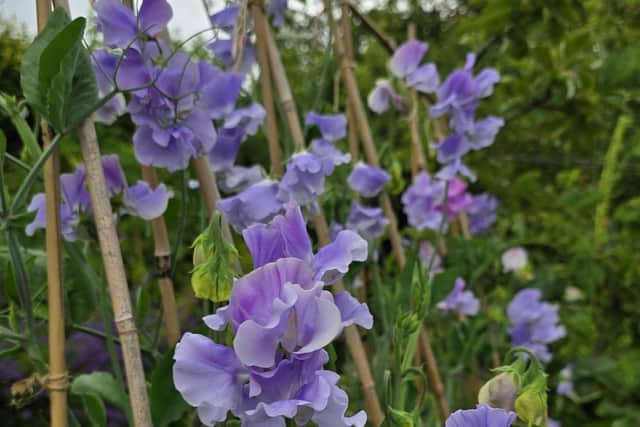
Our sweet peas are grown singly up a cane structure and daily watering apart, need constant tying to their supports. Ignore them for two days at your peril because faded blooms, seed pods forming, and dry roots can hasten their demise.
As if these daily tasks were not enough the garden boundaries are marked on four sides by hedges, hawthorn, privet, mixed, and beech, each demanding the annual trim. This normally comes in June when bird nesting is over but this time delays occurred because there were second broods of blackbird, thrush and dunnock that took us into July. We are currently clipping from a ladder and contemplating regular trips to the local recycling with the resultant waste!