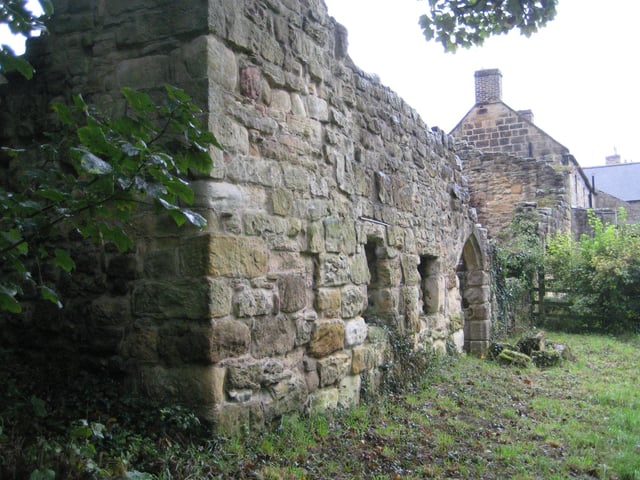
It wasn’t actually cold, just constantly raining. I got off the bus and headed for my first objective, St. Mary’s Chantry House.
Finding myself lost near Pottergate Tower, I happened to see a gentleman walking a friendly black dog and asked him the way. He wasn’t sure himself but took out his phone, brought up a map and set me to rights. So thank you, dear Sir. I’m much obliged.
St. Mary’s Chantry House is on Walkergate, a narrow lane near the Lion Bridge, quite off the usual tourist track.
A lady and gentleman were on hand to explain what it was all about. They had a folder full of pictures, fortunately sealed in plastic, and a neat printed leaflet to give away.
The Chantry House has no roof. Visitors came, took a look, and went, but these two were stood in the rain for the duration of their shift. They are heroes, and I only hope they didn’t catch cold.
The Chantry of Our Lady was not in the house itself but in a side chapel in the nearby parish church of St. Michael. It was served by two priests whose job was also to teach poor boys choral singing and Latin, both of which were needed for the daily services of those days and, in the case of Latin at least, a valuable means of personal advancement.
Henry VIII suppressed a few of the chantries, but he also recognised that most of them supported schools, so that it would be counter-productive to do away with them.
His son, the boy king Edward VI – or rather his protector, the Duke of Somerset – was more ruthless. In 1548 he suppressed the chantries as his father had suppressed the monasteries. They were shut down and their property acquired by the Crown.
The Act did however make provision for continuing the good work of the chantries, including the keeping of schools, and for the pensioning off of dispossessed priests. In the case of Alnwick, the King’s commissioners recognised that the priests, both aged 64, were making a good job of giving poor boys an education.
One of them accepted a pension while the other carried on keeping school at a salary of £4 1s 8d, which was evidently paid by the Crown out of the confiscated revenues. This would, however, have ceased with his death.
After that its history is obscure but it appears that the school carried on, presumably paid for out of the funds of the town guilds and by school pence, until a grammar school was built in Pottergate in 1630. The Chantry House then became simply a house, and later on a slum tenement.
Morpeth Chantry fared a lot better. We had friends at court, the most obvious being Dr. William Turner who is believed to have received his early education at the Chantry near the bridge. The young king refounded it as a grammar school managed by the town bailiffs, and endowed it with the chapel and other properties in the town, and with lands in Ponteland and Netherwitton.
We still have the building – with its roof on – housing the Tourist Information Centre, Craft Centre and Bagpipe Museum, and the school in the form of KEVI.
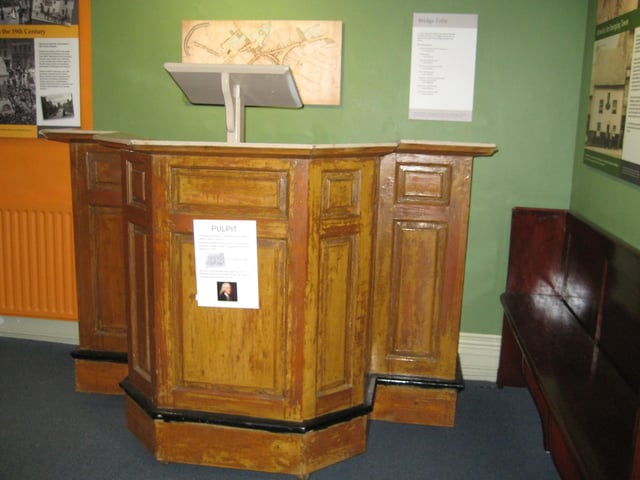
Next I went to the Bailiffgate Museum. It’s a really excellent museum and a credit to the town. One thing that caught my eye was John Wesley’s pulpit from the Methodist Church in Chapel Lane. The church closed in 2023 and the building sold, but Wesley’s pulpit now stands proudly in the museum. It wasn’t exclusively his, but he preached from it several times, the last occasion being on Sunday, May 5th 1788, about three years before he died.
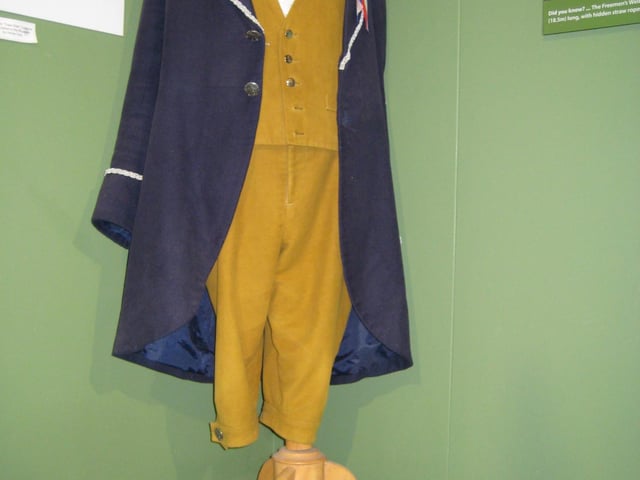
Something else I was particularly interested in (though there were plenty of others beside) was the waits’ uniform of blue coat, cocked hat and mustard coloured suit. Every town used to have its waits, usually just two. They were musicians but often had other functions as well, such as keeping watch at night.
They mostly died out in the 19th century with the advent of police forces and affordable clocks. The Alnwick Waits were abolished in 1831 though for what reason is not recorded.
Morpeth also had its waits, this from an advertisement in the Newcastle journal in May 1746:
"One of the Waits of Morpeth being dead, any Person that can play well upon the Hautboy and Fiddle will, on Application to the Magistrates of Morpeth, meet with encouragement. N.B.–It is a place of considerable profit."
There is no record of what they wore but it was probably similar to that in Alnwick. The Morpeth Waits were often called upon to attend the annual feasts of the seven guilds or companies of Morpeth, as well as the twice yearly baronial courts, the great annual fair and the riding of the bounds. William Woodman says,
"Until the passing of the Municipal Reform Act, the waits perambulated the town between 2 and 3 o’clock a.m. They consisted of a piper and fiddler ... When the waits came to the house of one of the Bailiffs, the music stopped a minute, one of them called 'a fine frosty morning, good morning Mr Bailiff,' and then on they went again."
The manikins at the Museum are particularly good.
Next to General Lambert’s House. I must often have walked by it without noticing, but apparently it was the office of an old-established firm of solicitors. It is large, derelict and in need of a new purpose in life. The most curious thing is that there never was a General Lambert. The man who built it was John Lambert, a lawyer, and one theory about the apocryphal name is that it arose from the common abbreviation for John, “Jno.”
And so to lunch. Grannies was full, so I went to Efe’s Turkish Grill House where I had tomato soup and a pot of tea – exactly what I wanted.
A quick whirl to the Youth Hostel; it was originally a police station, bridewell (gaol for disorderly persons and petty criminals) and courthouse. Well worth a visit, including the story of the Edlingham burglary, which led to a change in the law.
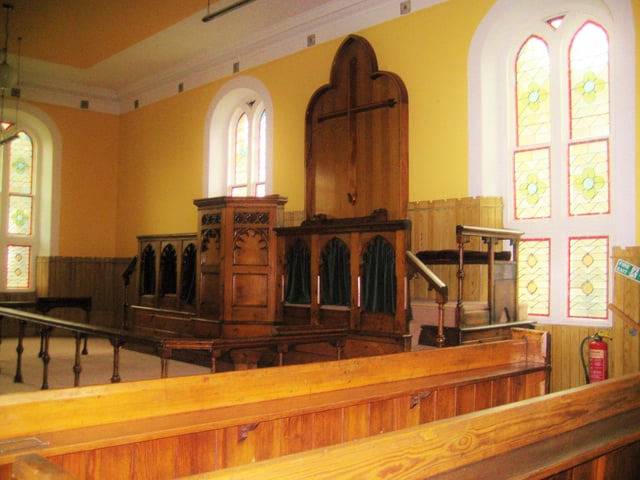
And finally to the former Methodist Church. This is another building looking for a new purpose in life, except that, unlike General Lambert’s House, it is being beautifully maintained by the agents, Alnwick Properties.
That done, I walked to Barter Books, caught the bus to Morpeth and went home to dry out.