
Morpathia - Edward I levies a tax
We have a surprising amount of information about the inhabitants of Morpeth and their wealth in the year 1296, thanks to the warlike propensities of Edward I.
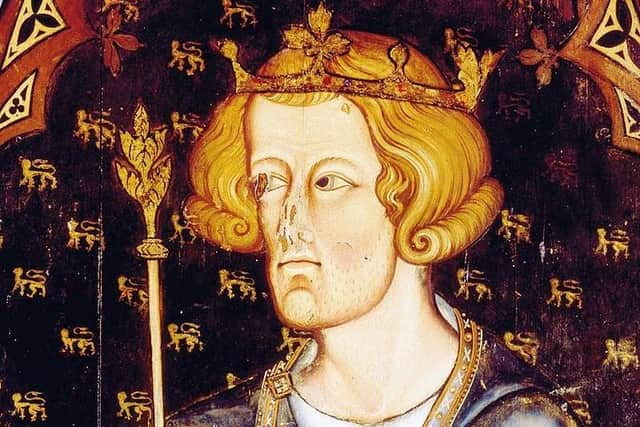
Edward came to the throne in 1272. He was over six foot tall, an energetic reformer and a renowned soldier.
He fought in Wales in 1263, defeated the rebel baron Simon de Montfort in 1265, went on crusade in 1268, fought the Welsh again in 1278 and 1283, and the French in 1294.
In November 1295, parliament approved a Lay Subsidy – which of course did not apply to the Clergy or the Church – to pay for Edward’s planned invasion of Scotland. Subsidies were a relatively new form of taxation first used a century earlier by Henry II, in 1187, to raise money for a crusade to retake Jerusalem from the Saracens. It was known as the Saladin Tithe.

The Saladin Tithe was levied at the rate of one tenth of your personal property. It was collected by the church authorities with help from some secular officials, but not from the king’s officers, the sheriffs.
Henry, incidentally, never did use the money for its stated purpose. Some went on fighting Philip II of France, with whom he was supposed to be going on crusade, and he died in 1189 – as a divine punishment, many thought, for imposing so harsh a tax.
The Saladin Tithe established two important principles, first that it was levied on moveable property, and secondly that your liability was determined by a local jury.
Kings were always looking for ways to raise money, and although they continued to collect taxes on the Saladin principles from time to time, it was always regarded as a departure from regular practice, being collected by ad hoc officials rather than by the royal exchequer.
Edward I did this a couple of times, but in 1290 he brought it firmly into the fold of regular taxation by putting the exchequer in charge of personal taxation as well as of the traditional taxes on landed property or in lieu of military service. He then took a leaf out of the book of the late rebel, Simon de Montfort, and called two burgesses from selected towns to parliament, as well as the two knights from each shire.
Combining the two – the principles of the Saladin Tithe and the principle of summoning burgesses to parliament – made it more acceptable for him to raise money from the growing middle class in the towns. Morpeth, by the way, was not then a parliamentary borough.
The subsidy of 1290 was in gratitude for him expelling the Jews – another idea he got from Simon de Montfort, who had expelled the Jews from Leicester in 1231.
It granted him another subsidy in 1294, for his war with France, and this one in 1295 to fight the Scots.
Two commissioners were appointed for each county, to supervise the local juries and collectors, keep full accounts, and pay the proceeds into the exchequer.
Sir Roger Mauduit of Eshot, knight, and Master Robert de Merlay, clerk, were the commissioners for Northumberland.
Frederick Bradshaw, writing in Archaeologia Aeliana in 1916, speculated that the latter might have been a junior member of the de Merley family of Morpeth, but there’s no way of knowing. There were too many people called de Merlay, de Merley and Marley to be sure.
The regulations required the tax to be levied on the true value of a person’s goods at Michaelmas, after the harvest was in. The residents of rural areas paid one eleventh of the value of their goods, a little under a tenth, while cities, boroughs and market towns paid one seventh, which was considerably more.
The armour, riding horse, jewels and clothing of knights, gentlemen, and their wives, and their vessels of gold, silver and brass were exempt.
Merchants and townsmen were treated less liberally. Each was allowed his own garment and his wife’s, a double bed, one ring, one buckle of silver or gold and a silk girdle, provided these were in daily use, and either a drinking cup of silver or a mazer – a large cup, perhaps six inches or more in diameter, made of maple and often richly ornamented.
So much for the written rules. In 1934 an American scholar, James F. Willard, went deeply into the question of what was taxable and what exempt. He concluded that the assessors allowed a great many customary exemptions, some of which, though not all, had been spelt out in connection with earlier subsidies.
The underlying principle was that people should not be taxed on what they needed to live, like a workman’s tools or a peasant’s corn for the winter, nor on what pertained to their “dignity.” This explains why knights and gentlemen had more generous terms than merchants.
In rural areas the property taxed was exclusively agricultural: cattle, pigs, sheep, wheat, rye, oats, barley, maslin (wheat and rye mixed) and drage (another kind of mixed corn.) In some districts beans and peas were taxed.
The goods taxed in cities and towns included all of the above, except that the amounts involved were usually smaller, probably because town dwellers could buy in the market, whereas country people had to be self-sufficient.
The big difference, however, was in the articles of civilised life: rings, buckles, silver spoons and cups, clothing, towels, beds, sheets and bolsters, pitchers, bowls, brass pots, pans, measures and other utensils, and even malt, were taxed in cities and large towns.
In 1968 Constance Fraser edited and published the Northumberland Lay Subsidy roll in its entirety. Only three places were taxed at a seventh: the royal boroughs of Newcastle and Bamburgh, and Corbridge, which had been a royal borough until 1205. The baronial boroughs of Morpeth, Newbiggin, Rothbury, Alnwick and Alnmouth had their own juries separate from the jury for the surrounding ward, but paid at the country rate of one eleventh.
Morpeth was quite a poor town. It had only 35 taxable inhabitants, whose taxable wealth amounted only to £48. Even if you add Ulgham, which was a dependency of Morpeth and was perhaps where the lord of the manor, Sir John Greystoke lived, it only added 11 taxable inhabitants worth £20. Compare it in this table:
| Borough | Taxable persons | Assessment (to nearest £) |
| Newcastle | 295 | £949 |
| Corbridge | 77 | £159 |
| Alnwick | 50 | £103 |
| Newbiggin | 49 | £98 |
| Morpeth | 35 | £48 |
| Wooler | 34 | £136 |
| Alnmouth | 28 | £53 |
| Bamburgh | 28 | £32 |
| Rothbury | 24 | £37 |
| Mitford | 20 | £21 |
| Felton | 15 | £20 |
| Warkworth | 10 | £16 |
Notice that Wooler was surprisingly prosperous. Both it and Alnwick, and the ports of Newbiggin and Alnmouth, were worth more than Morpeth.
Bamburgh and Rothbury were examples of decayed royal boroughs. Yet another distinctive group is of former baronial boroughs and small market towns, including Mitford, Felton and Warkworth.
The difference is that, whereas all the others (excepting Newcastle of course) were in decline, Morpeth was on the up.
Books by Roger Hawkins are available at Newgate News, the Old Herald Office, The Dragon in the Clock Tower Books, and on Amazon.